Introduction to Understanding by Design (UbD)
developing teaching plans with the 'end in mid'

Dear Teacher
If you haven't heard about this framework for curriculum design, I strongly advise you to learn more about this. There is lots of good free stuff on the web, but I would also encourage you to read this excellent book on the subject by Grant Wiggins and Jay McTighe. There is also a 'handbook' which has lots of tools and examples to practice UbD.
I came across this approach around 2006 and have found it to be extremely powerful in first, understanding a topic more deeply and second, in building effective unit/ lesson plans to teach it. The purpose of this post is only to give you a brief introduction to this model, and hopefully inspire you to learn more about this and apply it in practice. I will be using the example of a unit on water and sustainability, but the approach is universal.
UbD requires the teacher to make a distinction between the enduring understandings of a unit from the other learning goals which are relatively less important. Simply defined, an enduring understanding is a big idea that we would like to leave the student with, at the end of a unit. For example, that water is a finite resource endlessly recycled through the Earth's systems is an important enduring understanding.
Students may also learn about the steps of the water cycle and how drinking and waste-water are treated-also important topics but these are not big ideas like the idea that water is a finite resource even though it is renewable.
Knowing what the big ideas are, helps the teacher to focus her instruction because she is clear about what is most important. Sometimes the big ideas may not be evident and will require reflection and discussion before these can be identified and articulated.
Another idea in UbD is that of essential questions- these questions are at the heart of the subject, are worth arguing about and often raise further questions. Importantly, such questions can provide an organizing purpose for connected and meaningful learning of the unit, and motivate learners to engage with the unit. For example,
"Will the next world war be fought over water?" and 'How do our personal choices affect the quality of water on Earth?" are essential questions that can provide an organizing purpose for a unit on water conservation.
In designing a unit plan using UbD, there are three stages as shown in the figure below. Stage 1 is to uncover the targeted understandings as we described above.
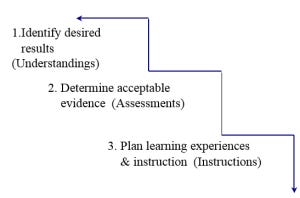
What is unique about this approach is that the design of the assessments (Stage 2) has to be thought through before planning the learning tasks (Stage 3) or the instruction plan. For this reason, it’s also called a ‘backward design model’.
Such an approach ensures that assessment is aligned to our highest priorities. This is quite rare actually.
It is common for a teaching unit to not focus on the kind of enduring understandings mentioned above (water is a finite resource even though it is renewable). It is even rarer for these goals to be assessed in a way that reveals actual understanding. For example, how many teachers would ask “As water is a renewable resource, why do we have a shortage of it?”
When a teacher asks herself a question like 'what would constitute acceptable evidence of understanding of sustainable water use?', a couple of things happen-
A stronger and more authentic assessment plan can be in place. e.g. a teacher may plan to assess students by asking them to build a water usage plan for their family/ community based on a rationed water supply, in additional to a conventional assessment tool like a quiz. Such an assessment has the potential to provide more authentic evidence of understanding than conventional tests.
Having clarity on the assessment plan allows the teacher to design better learning tasks. For example, the teacher may design a learning task that involves asking students to complete a 3 day home water use survey & calculate litres used by the household and per person, completing a histogram for entire class data and calculating the average per person water use for the class.
Notice how the boundaries between assessment and learning tasks start blurring in this approach- that is how all great teaching-learning should be!
As you start using UbD, you should be able to facilitate more and more understanding by design, and leave less and less of the understanding to evolve by accident.